
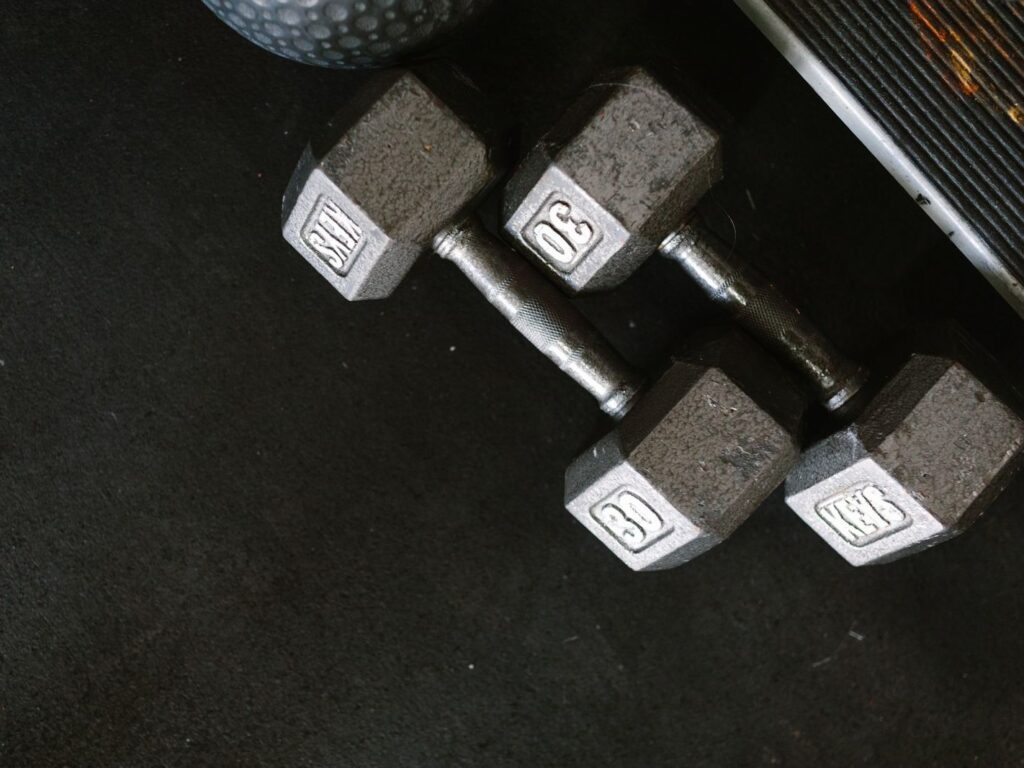
The farmer’s carry might be the simplest exercise in the gym: pick up two heavy weights and walk. Yet few movements build grip, core strength, posture and total-body toughness as quickly. Strongmen use it, fighters use it, and it carries straight over to everyday life, like hauling shopping bags or a water bottle up the stairs. This guide covers what the carry works, step-by-step farmer’s carry form, the most common mistakes, useful variations, and how to add carries to your week.
What the farmer’s carry works
Almost everything. Your forearms and grip work hardest to hold the weights, your traps and upper back keep your shoulders from being pulled down, and your abs, obliques and lower back fight to keep your torso upright with every step. Your glutes, legs and calves keep you moving. Because you are holding a heavy load for time, the carry also builds the kind of grip and core strength that makes your deadlift, barbell row and pull-ups feel stronger, and it is a great standing partner for the plank.
How to do a farmer’s carry with proper form
- Choose your weights. Start with a pair of dumbbells or kettlebells you could hold for about 30 to 40 seconds. Place one on each side of your feet.
- Pick them up like a deadlift. Hinge at your hips, keep your back flat, grip the handles in the middle and stand up by driving through your legs. Never round your back to lift them off the floor.
- Set your posture. Stand tall with your chest up and your shoulders pulled down and slightly back, as if you are putting them in your back pockets. Keep your arms straight by your sides and the weights from touching your legs.
- Brace and breathe. Tighten your abs as if you are about to be pushed. Take short, steady breaths behind that brace instead of holding your breath for the whole walk.
- Walk with short, controlled steps. Look straight ahead and walk heel to toe at a steady pace. Keep your hips level and do not let the weights swing.
- Finish and set down safely. Stop when your grip or posture starts to slip, then hinge back down and place the weights on the floor with a flat back. Rest and repeat.
Common farmer’s carry mistakes
- Going too heavy too soon. If you are shuffling, leaning or dropping the weights after ten steps, the load is too heavy. Clean posture matters more than the number.
- Shrugging or rounding the shoulders. Let your shoulders sit down and back. Shrugging tires your neck and rounding strains your upper back.
- Leaning to one side or arching the back. Stay stacked tall, with your ribs down over your hips.
- Rushing. Long, fast strides make the weights swing. Short steps keep you stable and make your core do the work.
- Lifting sloppily. Most injuries happen picking the weights up or putting them down, not during the walk. Treat both like a deadlift.
- Crushing the handle with a bent wrist. Keep your wrists straight and grip hard, with the handle deep in your palm rather than in your fingertips.
Farmer’s carry variations
- Suitcase carry. Carry one weight in one hand only. Your obliques have to work hard to stop you from leaning, which makes it one of the best core exercises around.
- Front rack carry. Hold two kettlebells at shoulder height. This targets your upper back and abs and is easier on the grip.
- Overhead carry. Hold one or two light weights locked out overhead. It builds shoulder stability, so keep the load light and your ribs down.
- Trap bar or handle carry. Once dumbbells get too light, a trap bar or farmer’s handles let you carry much heavier loads.
- Mixed carry. One weight at your side and one in the front rack or overhead, for an extra challenge to your balance.
Sets, distance and where to fit carries
Most people do best with 3 to 5 rounds of 20 to 40 metres, or 30 to 45 seconds, resting 60 to 90 seconds between rounds. Start with a pair of weights that adds up to roughly a third to a half of your bodyweight, and work towards carrying your full bodyweight split between both hands. Carries fit well at the end of a strength session, after Romanian deadlifts or kettlebell swings, or as a short finisher on conditioning days. Add a little weight or distance each week, the same progressive overload rule that works for every lift. If you are new to training, our beginner gym workout plan shows how to fit exercises like this into your week.
Safety tips
- Warm up first with a few light carries and some hip hinges. Our warm-up guide has a quick routine.
- Walk in a clear lane on a flat, non-slippery floor and look where you are going.
- If you have a lower back, shoulder or hand injury, get your form checked by a coach and start light, or begin with the front rack carry.
- Dry your hands between rounds. Karachi’s humidity makes handles slippery, so keep a towel nearby or use a little chalk.
- Stop if you feel sharp pain in your back, shoulder or elbow, and keep sipping water between sets.
Train farmer’s carries at Body Evolution
Body Evolution has two floors of Matrix equipment, with heavy dumbbells, kettlebells and plenty of floor space for carries and the strength work around them. If you want a coach to check your form and build a programme around your goals, our personal training team can help, and our guide to building muscle in Karachi shows how exercises like this fit into a full plan. Men who love free weights can join Sparta at Solace by BE, our wellness studio, on weekdays from 4 to 5 PM (book a slot by messaging us on Instagram at @bodyevolution.pk). Women can join Project Her classes or train in our private ladies gym, and anyone can build the grip and conditioning that fighters rely on in our MMA classes. Compare memberships on our gym fees page, see why members call us the best gym in Karachi, or join Body Evolution today.
This article is educational and is not a substitute for individual medical, nutrition or rehabilitation advice. If you have a health condition, injury or specific dietary needs, consult an appropriately qualified professional.