The plank looks like the easiest exercise in the gym: you just hold still. Yet it is one of the most commonly botched moves on any gym floor, with hips sagging towards the mat, backsides pushed up in the air and people watching the clock instead of their body. Done properly, the plank builds a strong, stable core that protects your lower back and makes every big lift safer, from squats to deadlifts. This guide covers what the plank works, step-by-step plank form, how long you should actually hold it, the best variations, common mistakes and a simple core plan you can add to your training.
What the plank works
The plank is an anti-extension exercise: your job is to stop your spine from bending while gravity tries to pull your hips down. It mainly trains your rectus abdominis (the six-pack muscle) and the deep transverse abdominis that acts like a natural weight belt. Your obliques, glutes, shoulders and the muscles along your spine also work hard to hold you in a straight line. A strong core does not just look good; it helps you brace under a heavy barbell, keeps your back healthier if you spend long hours at a desk or in Karachi traffic, and transfers force better in sports and MMA.
How to do a plank with proper form
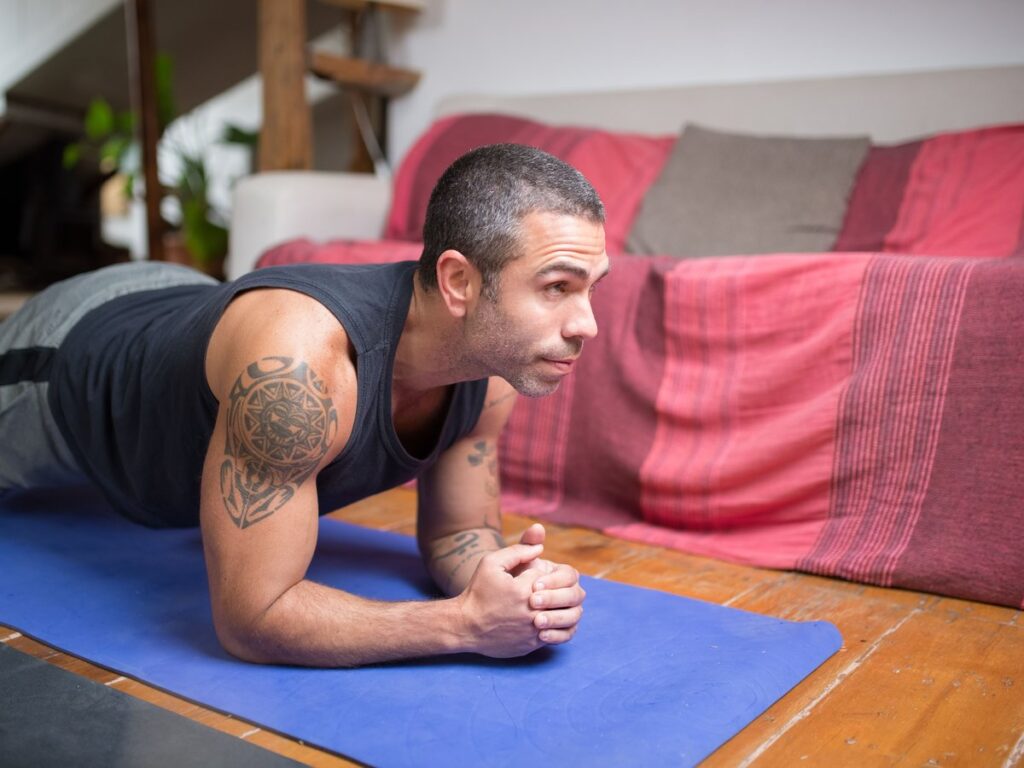
- Set your elbows. Kneel on a mat and place your forearms on the floor with your elbows directly under your shoulders, forearms parallel or hands lightly clasped.
- Step back. Extend one leg back, then the other, so you rest on your forearms and toes with feet about hip-width apart.
- Make a straight line. Your head, upper back, hips and heels should form one straight line. Look at the floor just in front of your hands so your neck stays neutral.
- Tuck your pelvis slightly. Gently tilt your hips under, as if pulling your belt buckle towards your chin. This flattens your lower back and switches your abs on.
- Squeeze everything. Brace your stomach as if someone is about to poke you, squeeze your glutes hard and push the floor away with your forearms so your shoulder blades do not sink.
- Breathe. Take short, controlled breaths through your nose while keeping the brace. Holding your breath will make you shake and quit early.
- Stop when form breaks. End the set the moment your hips sag or rise, not when a timer says so.
How long should you hold a plank?
Longer is not better. Once you can hold a perfect plank for about 60 seconds, adding more time mostly trains patience. A better approach is several shorter, harder sets: 3 to 4 rounds of 20 to 45 seconds with maximum tension, resting 30 to 60 seconds between them. Beginners can start with 3 sets of 15 to 20 seconds. When 45 seconds feels easy, make the exercise harder with a variation instead of chasing a five-minute record. This is the same idea as progressive overload with weights: make it gradually more challenging over time.
Plank variations
- Knee plank: the same position on your knees instead of your toes. A good starting point for complete beginners or after a break.
- High plank: on straight arms, like the top of a push-up. Slightly easier on the core and good shoulder-stability work.
- Side plank: on one forearm with your body turned sideways. Targets the obliques and the side of your hips; do both sides.
- RKC plank: a short, extremely tight plank where you pull your elbows towards your toes and squeeze your glutes as hard as possible. 10 to 20 seconds is plenty.
- Plank shoulder taps: from a high plank, tap each shoulder with the opposite hand without letting your hips rock.
- Weighted plank: a coach or training partner places a plate on your upper back. Only once you can hold 60 seconds with perfect form.
- Stability-ball or body-saw plank: forearms on a ball, or sliding forwards and back on your toes. Advanced, and very hard on the abs.
Common plank mistakes
- Sagging hips: this loads your lower back instead of your abs. Squeeze your glutes and tuck your pelvis.
- Hips too high: a pike position takes the work off your core. Lower your hips until your body is straight.
- Head dropping or craning up: keep your neck in line with your spine and look just ahead of your hands.
- Shoulders sinking: push the floor away so your upper back stays rounded slightly and your shoulders stay over your elbows.
- Holding your breath: breathe in short, steady breaths while staying braced.
- Chasing time with bad form: a perfect 30 seconds beats a sloppy three minutes every time.
A simple core plan
Add core work to the end of two or three sessions a week; you do not need a separate abs day. A balanced routine might look like this:
- Front plank: 3 sets of 20 to 45 seconds
- Side plank: 2 to 3 sets of 15 to 30 seconds per side
- Dead bug or hanging knee raise: 3 sets of 8 to 12 slow reps
- Rest 30 to 60 seconds between sets
Pair it with your main lifts, such as the bench press, barbell row and leg press, whether you follow a full-body or split routine. If you are new to the gym, our beginner workout plan shows where core work fits in.
Will planks give me a flat stomach?
Planks build strong abdominal muscles, but they will not burn the fat that covers them. You cannot spot-reduce belly fat with core exercises. Visible abs come from overall fat loss: a sensible calorie deficit, enough protein, regular strength training, daily movement and good sleep. Think of planks as building the muscle, and your diet as uncovering it.
Safety tips
- Always warm up first; a few minutes of light cardio and some cat-cow stretches prepare your spine.
- If you feel pain in your lower back rather than effort in your stomach, stop, reset your hips and try a shorter hold or a knee plank.
- If you have a shoulder or wrist injury, choose forearm planks over high planks, and check with a doctor or physiotherapist if pain continues.
- Pregnant women and anyone recovering from abdominal surgery should get medical advice before planking.
- Drink plenty of water, especially in Karachi’s heat.
Build a stronger core at Body Evolution
Body Evolution in Bahadurabad has two floors of Matrix equipment with open floor space, mats, stability balls and plates for every plank variation and core exercise you need. If you want a coach to check your form and build a programme around your goals, our personal training team can help, and our muscle-building guide is a good next read. Men who love free weights can join Sparta at Solace by BE, our wellness studio, on weekdays from 4 to 5 PM (book a slot by messaging us on Instagram at @bodyevolution.pk). Women can join Project Her classes or train in our private ladies gym, and anyone can build serious core strength and conditioning in our MMA classes. Compare memberships on our gym fees page, see why members call us the best gym in Karachi, or join Body Evolution today.
This article is educational and is not a substitute for individual medical, nutrition or rehabilitation advice. If you have a health condition, injury or specific dietary needs, consult an appropriately qualified professional.