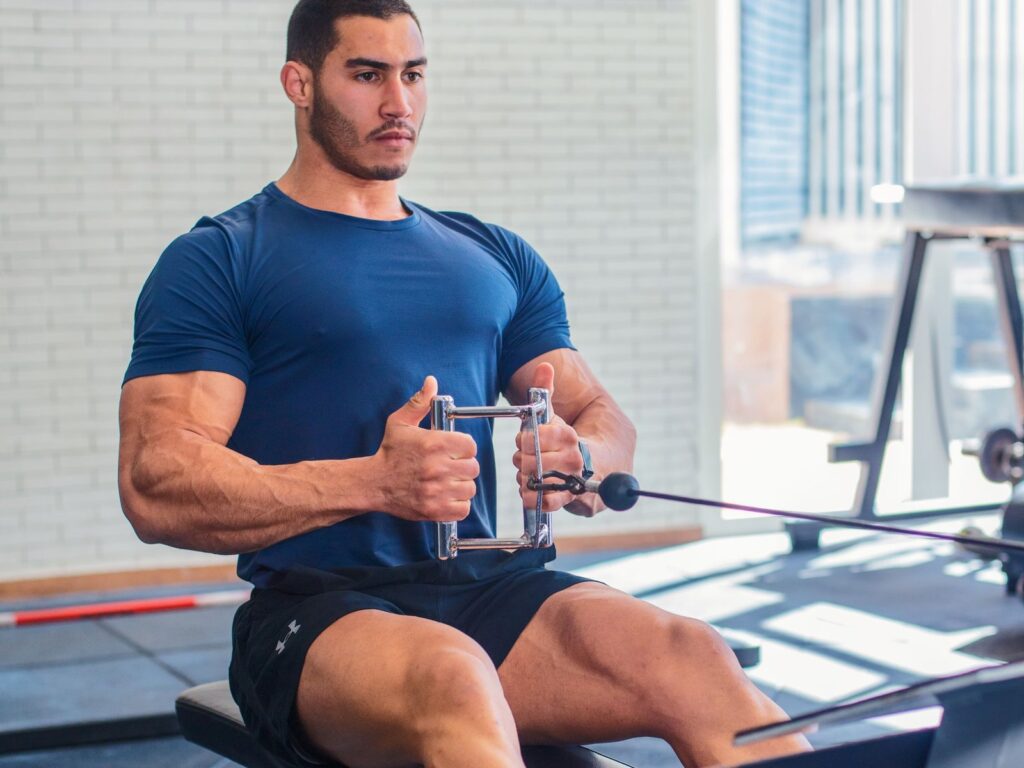
The seated cable row is one of the best exercises for building a thick, strong back without loading your spine the way a barbell does. The cable keeps tension on your muscles through the whole movement, the seat keeps you stable, and the weight is easy to adjust, which makes it a great choice for beginners and experienced lifters alike. This guide covers what the seated cable row works, step-by-step seated cable row form, the most common mistakes, useful variations, and how to fit it into your week.
What the seated cable row works
The main movers are your lats and the muscles of your mid-back: the rhomboids and middle traps that pull your shoulder blades together. Your rear delts and biceps help with the pull, and your lower back and core work to keep your torso still. Strong mid-back muscles improve your posture, protect your shoulders, and give you a solid base for the bench press. It pairs well with the lat pulldown, which trains the back from a vertical angle, and it is a gentler alternative to the barbell row on days when your lower back needs a break.
How to do a seated cable row with proper form
- Set up the machine. Attach a close-grip V-handle, sit on the bench and place your feet firmly on the foot plates with your knees slightly bent.
- Grab the handle and sit tall. Reach forward, take the handle, then sit back until your torso is upright and your arms are straight. Your chest is up and your lower back keeps its natural arch.
- Brace your core. Tighten your abs as if you are about to be pushed, so your torso stays still for the whole set.
- Pull with your back, not your arms. Start the movement by drawing your shoulder blades back, then drive your elbows behind you, keeping them close to your sides. Pull the handle to your lower ribs or upper stomach.
- Squeeze and pause. Hold for a second with your chest proud and your shoulder blades squeezed together. Keep your shoulders down, away from your ears.
- Return under control. Let your arms straighten slowly over two to three seconds and allow your shoulder blades to stretch forward a little, without rounding your lower back. Breathe out as you pull and in as you return.
Common seated cable row mistakes
- Rocking back and forth. Swinging your torso to move the weight turns a back exercise into a lower back strain. If you have to lean far back to finish each rep, the weight is too heavy.
- Pulling only with the arms. If your biceps burn long before your back, think about pulling your elbows back rather than pulling the handle with your hands.
- Shrugging. Lifting your shoulders towards your ears shifts the work to your upper traps and neck. Keep them down and back.
- Rounding the lower back. Reaching too far forward at the start of each rep puts your spine in a weak position. Stretch from your shoulder blades, not your waist.
- Locking the knees. Straight legs pull your hips into a rounded position. Keep a soft bend.
- Rushing the return. Letting the stack crash down wastes half the exercise. Control the weight on the way back.
Seated cable row variations
- Wide-grip row. Use a long straight bar with a wide overhand grip and pull to your lower chest. This shifts more work to your upper back and rear delts.
- Single-arm cable row. Row with one D-handle at a time to fix strength differences between sides and add a rotation challenge for your core.
- Underhand-grip row. A straight bar with palms facing up brings in more biceps and lower lats.
- Rope row to face. Pull a rope towards your face with your elbows high, a great option for shoulder health and rear delts.
- Chest-supported row. If your lower back is sore, a chest-supported machine row or dumbbell row trains the same muscles with no strain on your spine.
Sets, reps and where to fit cable rows
For muscle growth, most people do best with 3 to 4 sets of 8 to 12 reps, resting 60 to 90 seconds between sets. Choose a weight you can pull for every rep without rocking, with one or two good reps left in the tank. Cable rows fit well on a back or pull day after pull-ups or deadlifts, or in a full-body session alongside a pushing exercise like dips or push-ups. Add a little weight or a rep or two each week, the same progressive overload rule that works for every lift. If you are new to training, our beginner gym workout plan shows how to fit exercises like this into your week.
Safety tips
- Warm up first with a light set or two and some arm circles. Our warm-up guide has a quick routine.
- Check the pin is fully pushed into the weight stack and the handle is clipped on securely before you sit down.
- When you finish, lean forward slightly and let the weight down gently instead of letting go at full stretch.
- If you have a lower back or shoulder injury, start light, try the chest-supported row, and get your form checked by a coach.
- Dry your hands between sets, as Karachi’s humidity makes handles slippery, and keep sipping water through your session.
Train cable rows at Body Evolution
Body Evolution has two floors of Matrix equipment, including cable stations and row machines, so you can train your back from every angle. If you want a coach to check your form and build a programme around your goals, our personal training team can help, and our guide to building muscle in Karachi shows how exercises like this fit into a full plan. Women can join Project Her classes at Solace by BE, our wellness studio, or train in our private ladies gym, and anyone can build the pulling strength fighters rely on in our MMA classes. Compare memberships on our gym fees page, see why members call us the best gym in Karachi, or join Body Evolution today.
This article is educational and is not a substitute for individual medical, nutrition or rehabilitation advice. If you have a health condition, injury or specific dietary needs, consult an appropriately qualified professional.