
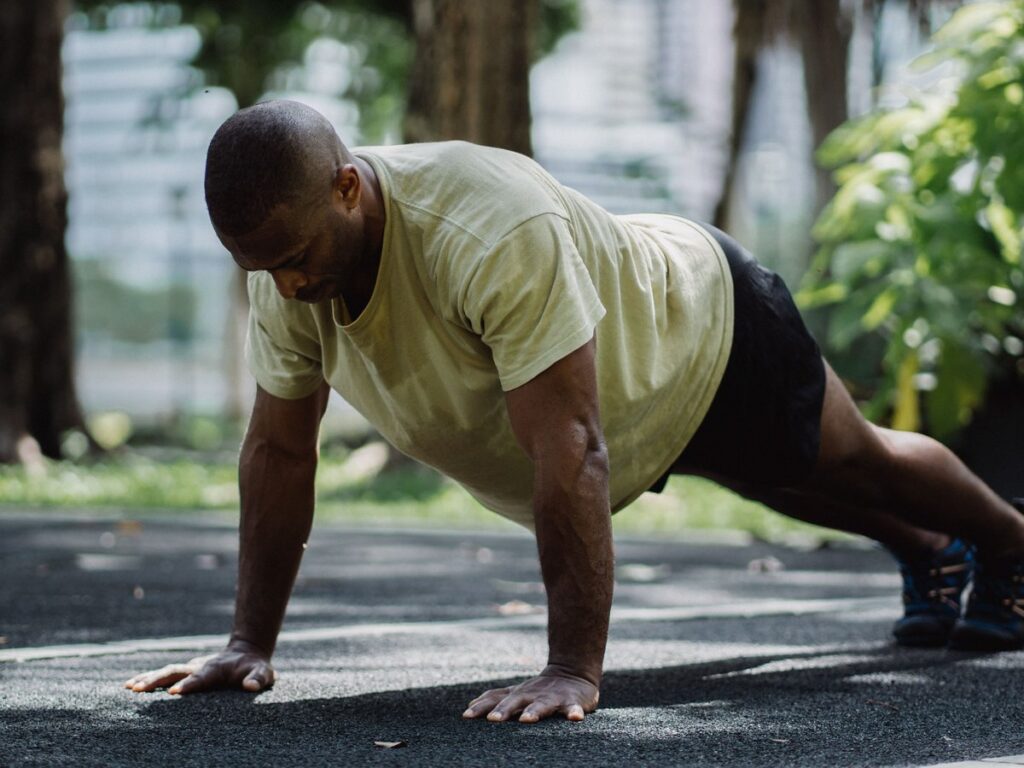
Everyone thinks they know how to do a push-up, yet most people in the gym do them badly: hips sagging, elbows flared straight out, heads bobbing towards the floor and reps cut halfway. Done properly, the push-up is one of the best upper-body exercises there is. It needs no equipment, builds your chest, shoulders and triceps, trains your core like a moving plank, and carries over directly to the bench press. This guide covers what push-ups work, step-by-step push-up form, the most common mistakes, how to progress from your first rep to sets of twenty and beyond, and a simple plan you can follow at the gym or at home.
What push-ups work
The push-up is a horizontal pushing movement. The main muscles are your chest (pectoralis major), the front of your shoulders (anterior deltoids) and your triceps. Because your body has to stay rigid from head to heels, your abs, obliques and glutes work hard too, and the serratus anterior around your ribs helps keep your shoulder blades healthy. Unlike the bench press, your shoulder blades move freely during a push-up, which many people find kinder on their shoulders. That makes push-ups a great choice for beginners, a useful finisher for experienced lifters, and a staple of MMA and combat-sports conditioning.
How to do a push-up with proper form
- Set your hands. Place your hands on the floor slightly wider than shoulder-width, roughly in line with your lower chest, fingers spread and pointing forward.
- Get into position. Step your feet back so your body forms a straight line from head to heels. Feet can be together or hip-width apart; wider is a little more stable.
- Brace. Squeeze your glutes, tighten your stomach as if someone is about to poke it, and keep your neck neutral with your eyes on the floor slightly ahead of your hands.
- Lower with control. Bend your elbows and lower your whole body as one unit, taking about two seconds. Keep your elbows at roughly 30 to 45 degrees from your sides, so from above your body and arms make an arrow shape, not a T.
- Touch depth. Go down until your chest is a fist’s height or less from the floor. Your hips should arrive at the same time as your chest, not later.
- Press back up. Push the floor away, straighten your arms fully and spread your shoulder blades slightly at the top. Breathe in on the way down and out on the way up.
Common push-up mistakes
- Sagging hips. If your lower back dips, your core has switched off and your spine takes the strain. Squeeze your glutes and shorten the set, or move to an incline push-up.
- Hips in the air. Piking up turns the push-up into a lazy shoulder exercise. Keep that straight line from head to heels.
- Elbows flared to 90 degrees. This is the classic shoulder irritant. Tuck the elbows to about 45 degrees.
- Half reps. Dropping a few centimetres and calling it a rep builds very little. Full range with fewer reps beats many partial reps.
- Leading with the head. Poking your chin towards the floor makes reps look deeper than they are and strains your neck. Keep your head in line with your body.
- Rushing. Bouncing out of the bottom uses momentum instead of muscle. Control the way down and pause briefly if you need to.
Can’t do a push-up yet? Start here
There is no shame in starting below a full push-up; it is simply the first rung of the ladder. The best regression is the incline push-up: put your hands on a bench, a box or a Smith machine bar so your body is at an angle. The higher your hands, the easier it is. Lower the surface a little every week or two until you reach the floor. Knee push-ups also work, but incline push-ups teach the full-body brace better. Negatives help too: start at the top of a full push-up and lower yourself as slowly as you can, then reset on your knees and repeat.
Push-up variations to make it harder
- Tempo push-ups: take three to four seconds to lower. Simple, brutal and great for building strength.
- Decline push-ups: feet on a bench puts more load on your upper chest and shoulders.
- Close-grip (diamond) push-ups: hands closer together shift more work to the triceps.
- Weighted push-ups: a plate on your upper back, or a weighted vest, lets you keep adding load using progressive overload.
- Deficit push-ups: hands on two plates or push-up handles let your chest drop lower for a bigger stretch.
- Explosive push-ups: push hard enough for your hands to leave the floor; useful for power and fight conditioning.
How many push-ups should you do?
For most people, two to four sets two or three times a week is plenty. If you are building up to your first full push-ups, do three sets of 6 to 10 incline reps and lower the surface as they get easy. If you can already do 10 to 20 good reps, three or four sets stopping one or two reps short of failure will build muscle well. Once you can comfortably do more than 25 clean reps, make the exercise harder with tempo, a deficit or added weight rather than chasing ever-higher numbers. A simple test: do as many perfect push-ups as you can in one set and note the number. Retest every four weeks; it is a great way to see your strength improving alongside a beginner gym plan.
A simple push-up plan for the week
- Day 1 (upper body): bench press or dumbbell press, then 3 sets of push-ups close to failure as a finisher.
- Day 2 (full body): 4 sets of tempo push-ups (3 seconds down), paired with rows or pull-ups to keep your shoulders balanced.
- Day 3 (conditioning): a short circuit of push-ups, bodyweight squats and planks, 30 seconds each, for 4 rounds.
Always pair pushing with pulling. A programme heavy on push-ups and bench press but light on rows and pulldowns is one of the most common causes of rounded shoulders and nagging shoulder pain.
Safety tips
- Always warm up first; arm circles, band pull-aparts and a few easy incline push-ups prepare your shoulders.
- If your wrists hurt, use push-up handles or dumbbells so your wrists stay straight, or do push-ups on your fists on a mat.
- Sharp pain at the front of the shoulder is a signal to stop, tuck your elbows more and reduce the range; see a doctor or physiotherapist if it continues.
- Expect some muscle soreness when you start, and leave at least a day between hard push-up sessions.
- Drink plenty of water, especially in Karachi’s heat, and support your training with enough protein.
Get stronger at Body Evolution
Body Evolution in Bahadurabad has two floors of Matrix equipment, with benches, plates, push-up handles and open floor space for every push-up variation, plus the barbells and machines to build on them. If you want a coach to check your form and build a programme around your goals, our personal training team can help, and our muscle-building guide is a good next read. Men who love free weights can join Sparta at Solace by BE, our wellness studio, on weekdays from 4 to 5 PM (book a slot by messaging us on Instagram at @bodyevolution.pk). Women can join Project Her classes or train in our private ladies gym, and anyone can build upper-body strength and conditioning in our MMA classes. Compare memberships on our gym fees page, see why members call us the best gym in Karachi, or join Body Evolution today.
This article is educational and is not a substitute for individual medical, nutrition or rehabilitation advice. If you have a health condition, injury or specific dietary needs, consult an appropriately qualified professional.