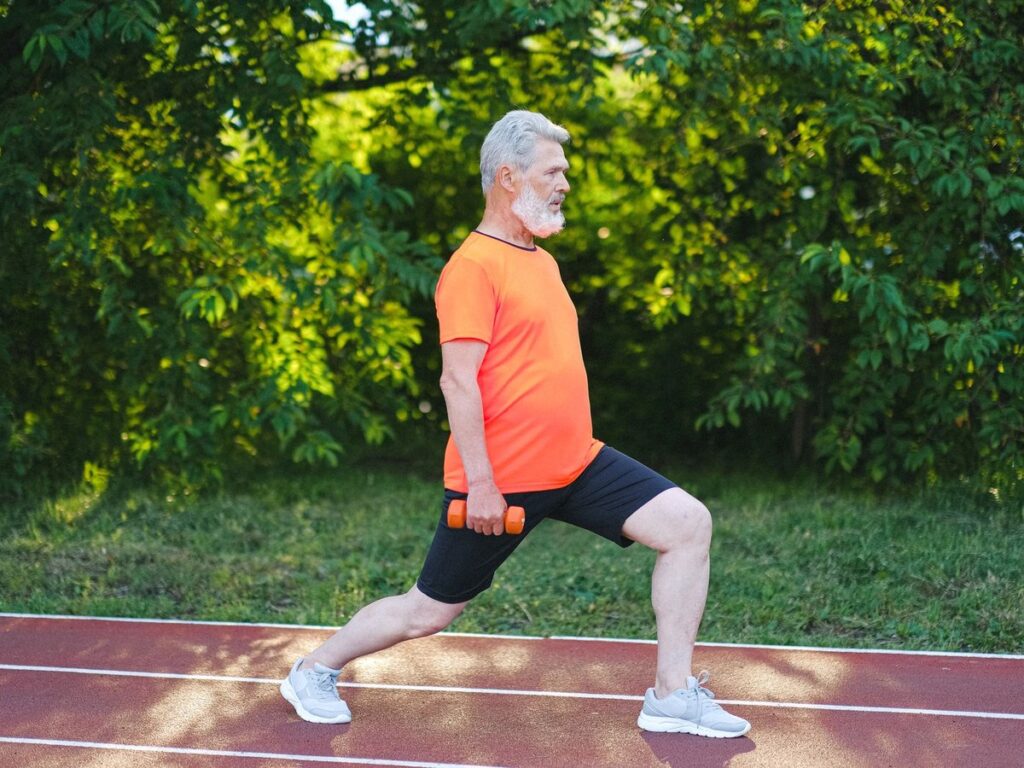
Lunges are one of the simplest leg exercises you can do, and one of the most useful. You need nothing more than your bodyweight or a pair of dumbbells, and you train each leg on its own, which builds balance, fixes left-right differences and carries over to walking, climbing stairs and almost every sport. They are also easy to get wrong: short wobbly steps, knees collapsing inwards and a torso that folds forward. Good lunge form turns a shaky exercise into one of the best builders of strong quads and glutes. This guide covers what lunges work, how to do them step by step, the main variations, common mistakes and a simple sets-and-reps plan.
What lunges work
Lunges mainly train your quadriceps and glutes, with your hamstrings, adductors and calves helping out. Because you stand on a split stance, your hip and core muscles also work hard to keep you balanced. That single-leg demand is what makes lunges different from a barbell squat or the leg press: they expose a weaker side and train it directly, and they load your spine much less than heavy squats or deadlifts. Most lifters use them as a second or third exercise on leg day.
How to do a lunge, step by step
Start with the reverse lunge. Stepping backwards is easier on the knees and easier to balance than stepping forwards, so it is the best version to learn first.
- Stand tall. Feet hip-width apart, chest up, shoulders relaxed and your core lightly braced. Hold dumbbells at your sides only once you can do 12 clean bodyweight reps per leg.
- Step back. Take a long step back with one foot, landing on the ball of that foot. Keep your feet roughly hip-width apart side to side, as if standing on two train tracks rather than a tightrope.
- Lower straight down. Bend both knees and drop your back knee towards the floor until it is just above the ground. Your front shin stays fairly vertical and your torso upright or leaning slightly forward.
- Keep the front knee in line. Your front knee should track over your middle toes. Do not let it cave inwards.
- Drive back up. Push through the whole front foot, especially the heel and midfoot, to stand up and bring your back foot forward to the start.
- Breathe and repeat. Breathe in on the way down and out on the way up. Finish all reps on one leg, or alternate legs, keeping the same depth every rep.
Lunge variations to try
- Reverse lunge: the best starting point; knee-friendly and easy to balance.
- Forward lunge: step forwards and push back to the start. Harder on balance and the knees, so progress here after mastering the reverse lunge.
- Walking lunge: step forward into each rep and keep moving. Great for conditioning and finishers, but you need clear floor space.
- Static split squat: keep both feet planted and just move up and down. The easiest way to learn the bottom position and to load heavier.
- Bulgarian split squat: rest your back foot on a bench behind you. A tough, very effective variation for quads and glutes.
- Dumbbell or barbell lunges: once your form is solid, add load with dumbbells at your sides first, then a barbell on your back for stronger lifters.
Common lunge mistakes
- Steps that are too short: a short stride pushes your front knee far forward and your heel off the floor. Take a longer step so both knees reach about 90 degrees at the bottom.
- Tightrope stance: placing one foot directly behind the other makes you wobble. Keep a hip-width gap between your feet.
- Knee caving in: if your front knee drops inwards, use less weight and think about pushing it out over your little toes.
- Slamming the back knee: lower under control and stop just above the floor instead of banging your knee into it.
- Pushing off the back foot: the front leg should do most of the work. If you bounce up off your back toes, you lose the training effect.
- Folding forward: a big forward lean with a rounded back usually means the weight is too heavy. Stay tall and brace your core.
Sets, reps and how often
For most people, 3 sets of 8 to 12 reps per leg works well, with 60 to 90 seconds of rest between sets. Beginners can start with bodyweight reverse lunges as part of a beginner gym workout plan and add dumbbells once the movement feels steady. Training legs two times a week is plenty, whether you follow a full-body or split routine. Use progressive overload: when you can do every set at the top of the rep range with clean form, use slightly heavier dumbbells next session.
A simple leg day could look like this: squats for 3 sets of 5 to 8, leg press for 3 sets of 10 to 12, dumbbell reverse lunges for 3 sets of 10 per leg, then calf raises for 3 sets of 15. Walking lunges also make a hard finisher for stamina and fat loss days. Pair them with upper-body days built around the bench press, barbell row and pull-ups and you have a complete week.
Safety tips
- Always warm up first, then do a set of bodyweight lunges before you pick up dumbbells.
- If you have knee pain, stick to reverse lunges or static split squats with a shorter range, and stop if you feel sharp pain.
- Hold onto a rack or bench with one hand if balance is a problem; it is better than wobbling with heavy weight.
- Expect some muscle soreness in your glutes after your first few lunge sessions; it should fade within two or three days.
- Recover with enough protein, good sleep and plenty of water, especially in Karachi’s heat.
Train legs at Body Evolution
Body Evolution in Bahadurabad has two floors of Matrix equipment, with plenty of dumbbells, benches, racks and open floor space for lunges, split squats and walking lunges, so you can build a full leg day without waiting. If you want a coach to check your form and plan your training around your goals, our personal training team can help, and our muscle-building guide is a good next read. Men who love free weights can join Sparta at Solace by BE, our wellness studio, on weekdays from 4 to 5 PM (book a slot by messaging us on Instagram at @bodyevolution.pk). Women can join Project Her classes or train in our private ladies gym, and anyone can build conditioning in our MMA classes. Compare memberships on our gym fees page, see why members call us the best gym in Karachi, or join Body Evolution today.
This article is educational and is not a substitute for individual medical, nutrition or rehabilitation advice. If you have a health condition, injury or specific dietary needs, consult an appropriately qualified professional.