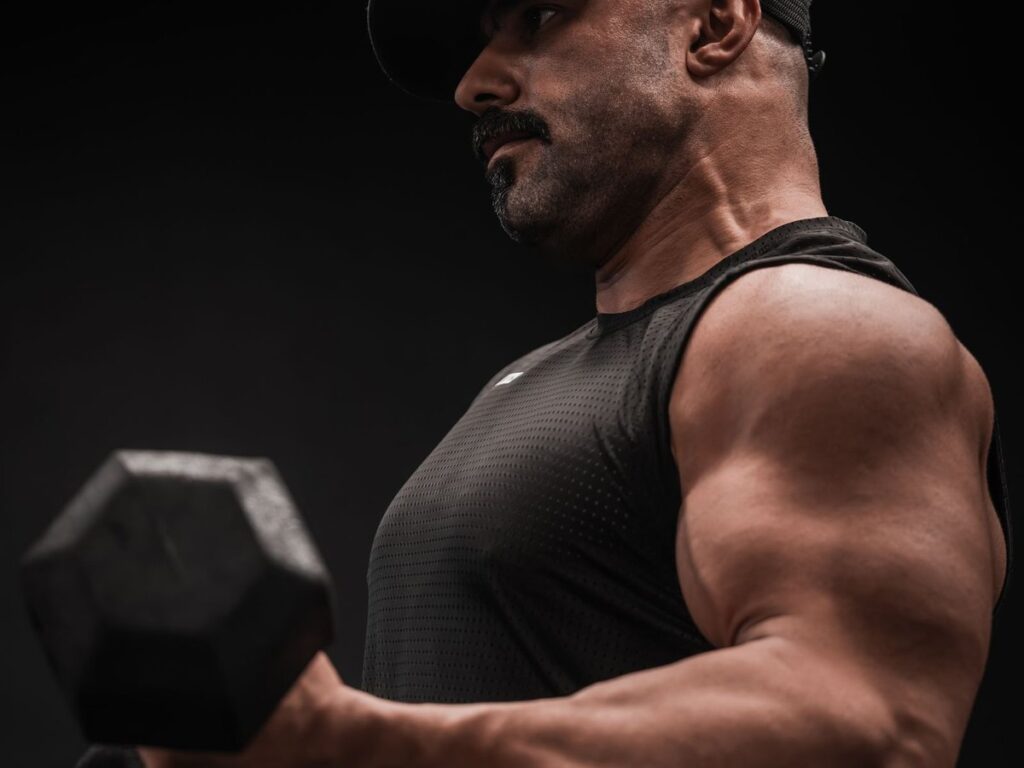
Bicep curls are probably the most popular exercise in any gym in Karachi. Walk past the dumbbell rack on a weekday evening and you will see a queue of people curling in front of the mirror. Yet most of those reps are wasted: bodies swinging, elbows flying forward and weights far too heavy to control. Good bicep curl form is not complicated, and once you get it right your arms will grow faster with less strain on your elbows and lower back. This guide covers what the curl works, how to do it step by step, the best variations, common mistakes and a simple sets-and-reps plan.
What bicep curls work
The main target is the biceps brachii, the muscle on the front of your upper arm that bends your elbow and turns your palm upwards. Curls also train the brachialis, which sits underneath the biceps and pushes it up to make your arm look thicker, and the brachioradialis on your forearm, which helps your grip. Big compound lifts such as the pull-up, barbell row and lat pulldown already work your biceps, so curls are best treated as a finishing exercise that adds extra size and strength on top.
How to do a dumbbell bicep curl, step by step
- Pick the right weight. Choose a pair of dumbbells you can lift for 10 to 12 clean reps without leaning back. For most beginners that is lighter than they expect.
- Stand tall. Feet about hip-width apart, knees soft, chest up and stomach braced. Let the dumbbells hang at your sides with your palms facing forward.
- Pin your elbows. Keep your elbows close to your sides, just in front of your hips. They should stay in roughly the same spot for the whole rep.
- Curl the weight up. Bend at the elbow and bring the dumbbells up towards your shoulders. Only your forearms should move.
- Squeeze at the top. Stop when your forearms are close to vertical, just before your elbows drift forward, and squeeze your biceps for a second.
- Lower slowly. Take two to three seconds to lower the dumbbells until your arms are almost fully straight, then start the next rep.
Breathe out as you curl the weight up and breathe in as you lower it. You can curl both arms together or alternate one arm at a time; alternating makes it easier to focus on each side.
Bicep curl variations worth trying
- Barbell curl. Lets you lift a little more weight with both arms together. Use a shoulder-width grip and keep the same strict form.
- EZ-bar curl. The angled grip is kinder to your wrists and elbows, which makes it a great choice if straight bars feel uncomfortable.
- Hammer curl. Palms face each other throughout. This shifts more work onto the brachialis and forearms for thicker-looking arms.
- Incline dumbbell curl. Sitting back on an incline bench stretches the biceps at the bottom of each rep and makes swinging almost impossible.
- Cable curl. A cable keeps tension on your biceps through the whole movement, including the top, where dumbbells get easier.
- Preacher curl. Resting your upper arms on a pad locks your elbows in place, so all the work goes to the biceps.
Common bicep curl mistakes
- Swinging the weight. If you are rocking your hips or leaning back to get the dumbbells up, they are too heavy. Drop the weight and keep your body still.
- Elbows drifting forward. Letting your elbows travel up turns the curl into a front raise and takes tension off the biceps. Keep them by your sides.
- Half reps. Stopping halfway down cuts out the hardest and most useful part of the movement. Lower until your arms are nearly straight every time.
- Dropping the weight. Letting the dumbbells fall on the way down wastes half the rep. The slow lowering phase builds a lot of muscle.
- Bending the wrists. Keep your wrists straight and strong rather than curling them in, which can strain your forearms.
- Skipping the warm-up. Elbows and wrists like a gentle start. A light set or two after a general warm-up routine is enough.
How many sets and reps?
For most people, two to four sets of 8 to 15 reps, stopping when you could do one or two more, works very well. Train your biceps two times a week, either at the end of a pull or back day or as part of a full-body session; our guides on how many days a week to work out and full-body vs split workouts can help you plan. When you can complete every set at the top of your rep range with clean form, move up to the next dumbbell. That steady, small increase is progressive overload, and it matters far more than any fancy variation.
Want bigger arms? Look beyond curls
Your triceps, on the back of your arm, make up around two-thirds of your upper arm, so pressing movements like the bench press and shoulder press matter just as much as curls. Arms also only grow when the rest of your plan supports them. Eat enough protein, using our guides on how much protein you need per day and the high-protein desi diet, refuel with a good post-workout meal and get proper sleep. Some muscle soreness after a new arm session is normal; sharp pain at the elbow is not, so stop and get your form checked.
Build your arms at Body Evolution
Body Evolution in Bahadurabad has a full range of dumbbells, EZ bars, preacher benches and Matrix cable stations, so you can try every curl variation in this guide. If you want a coach to fix your form and design an arm and full-body plan around your goals, our personal training team can help, and our muscle-building guide is a good next read. Men who love free weights can join Sparta at Solace by BE, our wellness studio, on weekdays from 4 to 5 PM (book a slot by messaging us on Instagram at @bodyevolution.pk). Women can join Project Her classes or train in our private ladies gym, and anyone can build conditioning in our MMA classes. Compare memberships on our gym fees page, see why members call us the best gym in Karachi, or join Body Evolution today.
This article is educational and is not a substitute for individual medical, nutrition or rehabilitation advice. If you have a health condition, injury or specific dietary needs, consult an appropriately qualified professional.